Part One: From Eden to Melanin
Have you ever started pulling on one small thread of curiosity and found yourself three hours later in a completely different universe of thought? That happened to me recently, and I want to take you along for the ride.
It started with one of the oldest questions in theology. If Adam and Eve were the first two people on earth and they only had two sons — where exactly did their wives come from?
Simple question. Surprisingly deep rabbit hole.
What the Bible Actually Says
It turns out Genesis 5:4 quietly mentions that Adam and Eve had other sons and daughters beyond the famous brothers. The two sons get the dramatic storyline, but the text acknowledges there were more children. So the most logically consistent answer — within a literal reading — is that Cain and Seth married their own sisters, or nieces from later generations.
Early church fathers like Augustine accepted this without much fuss. The reasoning was straightforward: early humanity had no prohibition against it, and genetic diversity wasn’t yet a concern.
Uncomfortable? Perhaps. But here’s where it gets genuinely fascinating.
We Are All, Technically, Cousins
If you follow that literal thread, the theological implication is breathtaking — racism becomes completely incoherent. If all humanity descends from two people, we are not just metaphorically family. We are literally family, every single one of us, regardless of skin colour, nationality, or belief system.
And here’s the thing — science arrives at exactly the same conclusion, just via a different route.
Modern genetics has identified what researchers call “Mitochondrial Eve” — the most recent common matrilineal ancestor of every living human being. Every person alive today traces their maternal line back to her. Scientists place her in Africa, approximately 150,000 to 200,000 years ago.
Scripture and science. Different timelines, different methods. Same destination.
Geneticists have also calculated that if you go back far enough — and it doesn’t take as long as you’d think, perhaps 3,000 to 4,000 years — every person alive today shares a common ancestor. Some researchers suggest that anyone with European ancestry is likely a literal descendant of Charlemagne.
We are squabbling with our own relatives. We always have been.
So Why Does Eve Look Like That?
Here’s the irony that stopped me cold.
If Mitochondrial Eve lived in Africa 150,000 years ago, she was almost certainly a dark-skinned woman with African features. And yet virtually every iconic depiction of Eve in Western art shows a fair-skinned, light-eyed European woman.
Why? Because the artists who created those images were European — Michelangelo, Raphael, Dürer — painting during the Renaissance and Medieval periods. They painted what they knew. They painted people who looked like themselves.
It wasn’t malicious. It was simply cultural projection. But those images became so dominant, so deeply embedded in popular imagination, that they hardened from artistic interpretation into assumed truth.
The same thing happened with Jesus, who was a Middle Eastern Jewish man routinely depicted as blue-eyed and fair-haired in Western churches for centuries.
Art shaped perception. Perception became assumption. Assumption became, for some, justification.
The Science of Skin — It’s Just Geography
So how did we get from one dark-skinned African ancestor to the extraordinary range of human skin tones we see today?
Sunlight. That’s genuinely the whole answer.
Dark skin evolved as protection in high-UV equatorial regions. Melanin acts as a natural sunscreen, preventing DNA damage. As human populations migrated north into Europe and Asia where sunlight is weaker, lighter skin became advantageous because it could absorb what little UV was available to produce sufficient Vitamin D.
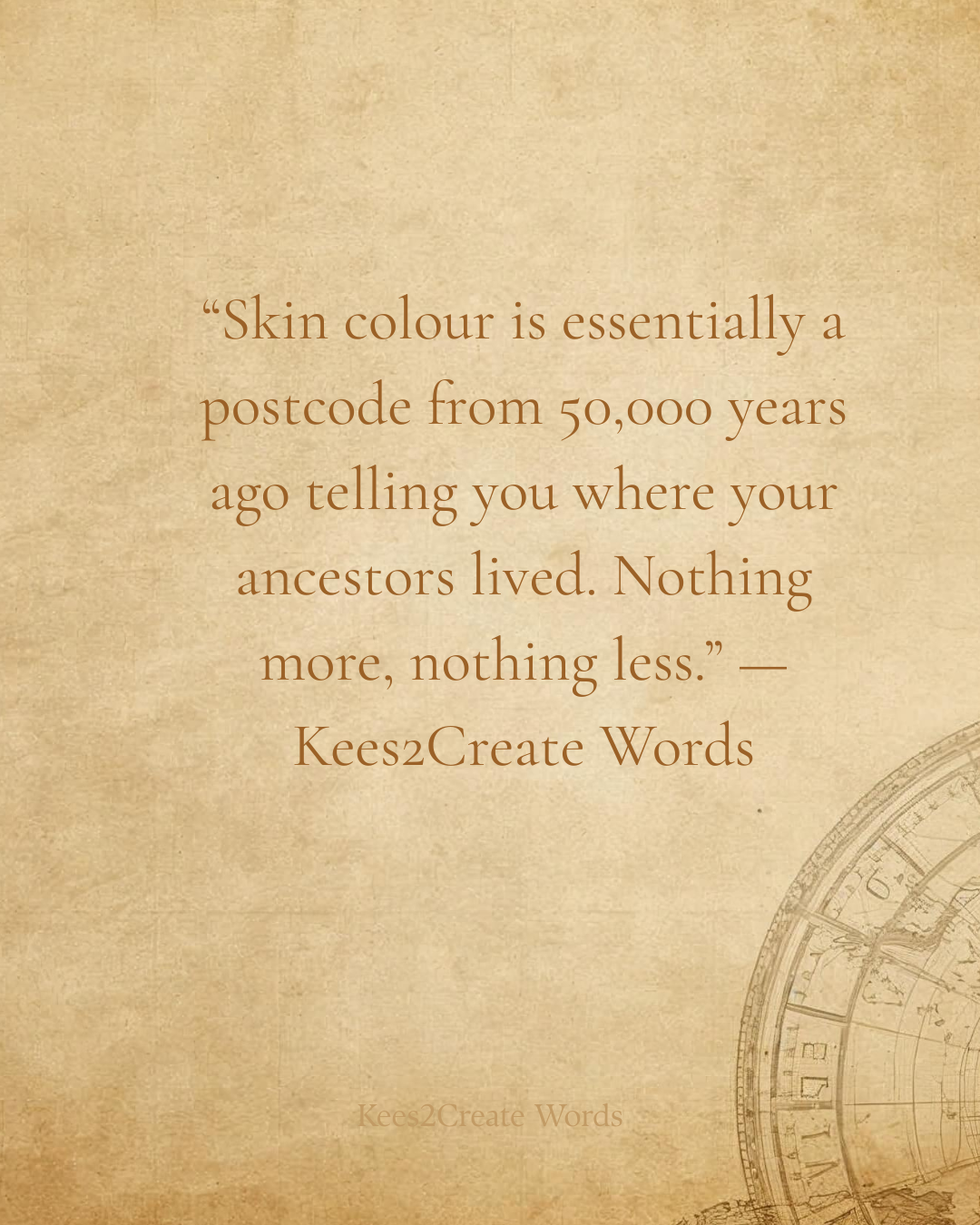
Your skin tone is essentially your ancestors’ postcode from 50,000 years ago. It tells you where they lived. Nothing more, nothing less.
And cultural and religious differences? Those emerged from 70,000 years of geographic isolation. Small groups migrated, separated, faced different environments and different survival challenges, developed different solutions, different stories, different spiritual frameworks — with no communication between them. Desert peoples, rainforest peoples, Arctic peoples — of course their relationship with the natural world looked different. The forms of belief diverged wildly. The underlying human need to find meaning never did.
Which Brings Us to Australia
Australia has the highest skin cancer rates in the world, and the reason is essentially a biological mismatch.
A large percentage of the Australian population carries fair skin inherited from European ancestors — skin that evolved for low-UV northern environments — now living under one of the most intense UV exposures on the planet. The southern hemisphere sits slightly closer to the sun during summer. The air is cleaner and clearer. The UV hits harder.
Dark-skinned people who migrate to Australia, research confirms, are at low risk for skin cancer even if they live their entire lives here. The melanin that evolved over millennia in high-sun environments does exactly what it was designed to do.
Meanwhile, Aboriginal Australians — whose ancestors evolved in high-UV environments and retained their protective pigmentation — have significantly lower melanoma rates than the European population that arrived and displaced them.
Nature had already solved the problem. The indigenous people of this land were perfectly adapted to it. The crisis of skin cancer in Australia is, at its biological core, the consequence of a population living in an environment their skin was never designed for.
There is a painful irony layered in there, if you sit with it.
The Thread Pulled to Its End
So here’s where the deep dive lands.
One theological question about where Cain’s wife came from leads, if you follow it honestly, to the conclusion that all of humanity is one family. Science confirms it through genetics. The diversity of our skin tones turns out to be nothing more than evolutionary adaptation to geography. Our cultural and religious differences are the natural result of thousands of years of isolation — different expressions of identical human needs.
And Australia’s skin cancer epidemic is, in a very real sense, a biological echo of colonial history.
None of this is divisive if you follow the logic calmly. It’s actually the opposite. The evidence — theological, genetic, evolutionary, medical — all points in the same direction …
We were always one family. We just forgot.
Further Reading
For anyone who wants to pull these threads further, the following works informed this series and are worth your time:
On human origins and early civilisation
- Harari, Y.N. (2011) Sapiens: A Brief History of Humankind — Harper Collins
- Diamond, J. (1997) Guns, Germs and Steel: The Fates of Human Societies — W.W. Norton
- Graeber, D. & Wengrow, D. (2021) The Dawn of Everything: A New History of Humanity — Farrar, Straus and Giroux
On the construction of race
- Painter, N.I. (2010) The History of White People — W.W. Norton
- Kendi, I.X. (2016) Stamped From the Beginning: The Definitive History of Racist Ideas in America — Nation Books
- Patterson, O. (1982) Slavery and Social Death — Harvard University Press
On scientific racism and its debunking
- Gould, S.J. (1981) The Mismeasure of Man — W.W. Norton
On Australian history in this context
- Reynolds, H. (1981) The Other Side of the Frontier — University of Queensland Press
- Atkinson, A. (1997) The Europeans in Australia — Oxford University Press
On skin cancer and UV adaptation in Australia
- Cancer Council Australia — cancercouncil.com.au
- Slevin, T. & Whiteman, D. (2016) Why Does Australia Have So Much Skin Cancer? — Cancer Council WA / The Conversation
Next week in Part Two: Who Guards the Grain — How Wanderlust Became Conquest
Juanita Kees writes romance and paranormal mystery, and occasionally disappears down research rabbit holes with no apology whatsoever. Find her fiction at https://juanitakees.com/ and https://raven-corbin.com/
 Kees2Create Words